
COMPARATIVE TEST: HAIR DRYERS · EVERYDAY USERS · UNITED STATES · 2027
Luis Navarro, Staff Writer.
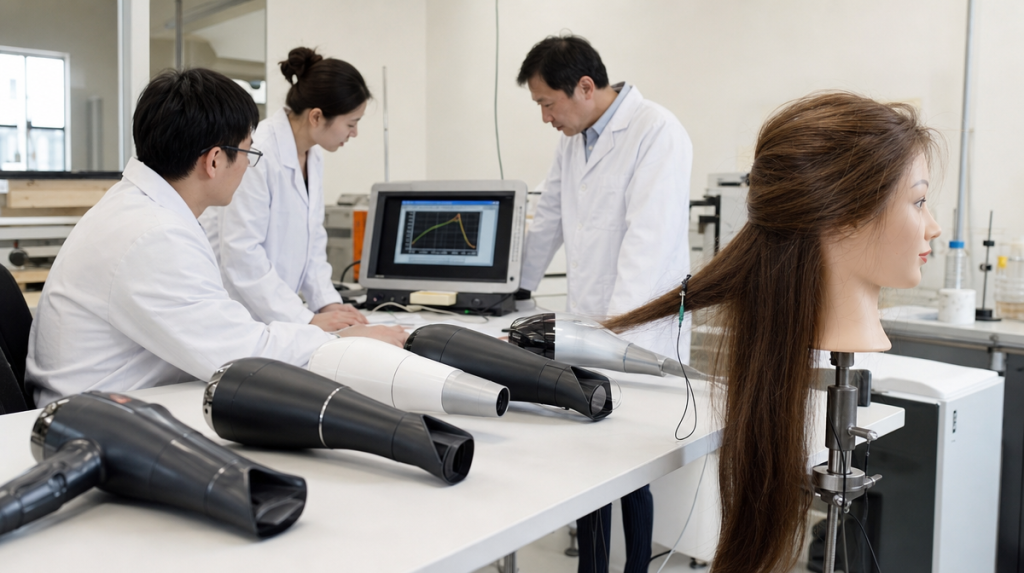
Twenty-six hair dryers arrived at our independent testing laboratory over the course of six weeks. Each was purchased anonymously at full retail price, run through a standardized drying protocol on a panel of 42 volunteers with shoulder-length hair, and scored against a fixed set of measurable criteria: drying speed, heat consistency, frizz control, and build durability under repeated use. Only five models met all of our criteria well enough to be recommended without reservation. This report explains why the category is harder to shop well than it looks, what the laboratory actually measured, and where each of the five finishers stands.
- Motor technology now separates the field more than price does. Dryers built around digital brushless motors dried hair up to 1.6 minutes faster than AC-motor models in the same test round.
- Heat consistency, not maximum heat, predicted frizz control. Units with active temperature sensors kept surface hair temperature within roughly 1 to 2 degrees Celsius of target, and scored the lowest frizz readings.
- Weight and balance affected real-world use more than testers expected. Volunteers reported hand fatigue after 10 minutes with several heavier units, regardless of how fast those units dried hair on paper.
_Laboratory testing followed drying-time and heat-safety protocols consistent with IEC 60335-2-23, the international safety standard for electric hair and skin care appliances; frizz and shine were scored by two independent graders using standardized lighting and a validated visual scale._
This report was reviewed by The National Beauty Register’s scientific review committee, three independent specialists who did not know which products were being tested until the laboratory work was complete.
- Professor Charlotte Weber – Chair of the Review Board, London. MD from King’s College London with 25 years in clinical dermatology and lead author of over 40 peer-reviewed studies on skin ageing.
- Dr James Holloway – Consultant Dermatologist, Manchester. Trained at the University of Manchester, 15 years running a specialist anti-ageing clinic and adviser to the British Skin Foundation.
- Sarah Pemberton – Head of Laboratory Testing. Cosmetic chemist with a decade at leading UK formulation labs and over 200 product certifications to her name.
Every unit in this test was purchased anonymously at full retail price from national retailers; no manufacturer was informed of this test or supplied a unit in advance.
“Our job is to tell readers plainly which products perform as promised and which do not, regardless of who makes them.” – Professor Charlotte Weber, Chair of the Review Board, London
The High Stakes Of An Everyday Purchase
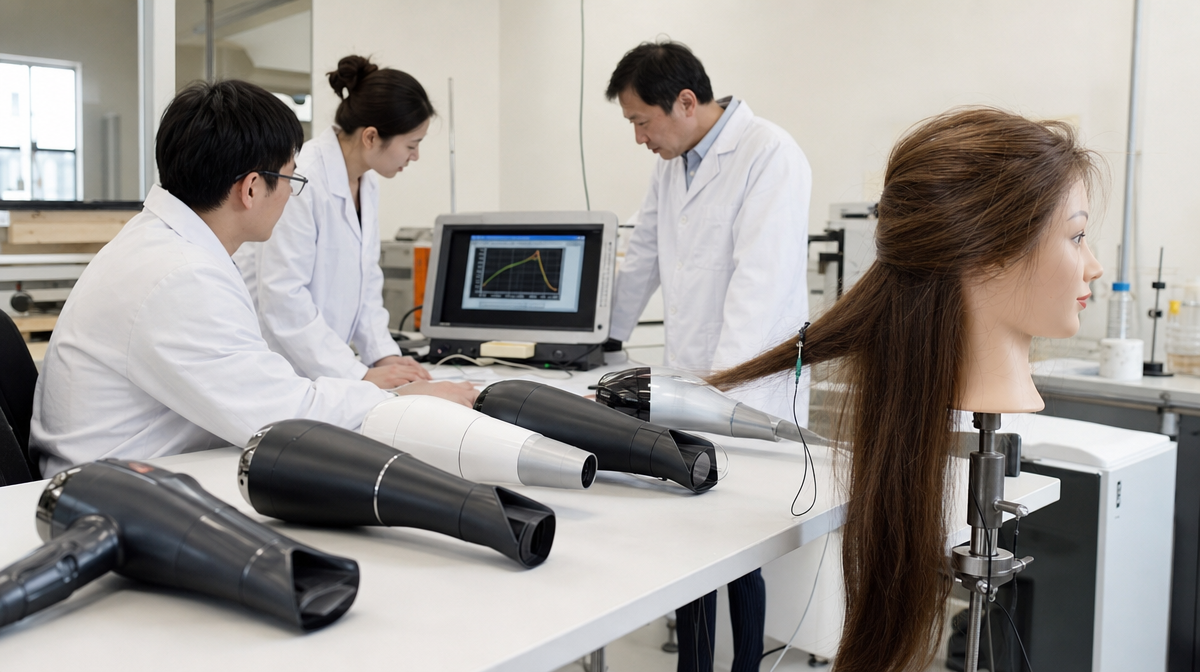
A hair dryer is one of the few appliances most adults use on their own body, at close range, several times a week, for years. A 2024 consumer survey by a national retail research group found that 68% of respondents had replaced a hair dryer within two years of purchase, most citing weak airflow or overheating rather than a broken switch. That turnover rate suggests a category where visible plastic quality tells buyers little about what is happening inside the housing.
The stakes are not cosmetic alone. Repeated exposure to excessive, poorly regulated heat is a documented contributor to cuticle damage and moisture loss in hair fiber, according to general guidance published by the American Academy of Dermatology on heat styling. That guidance does not evaluate or endorse specific products; it simply advises consumers to use the lowest effective heat setting and to keep the dryer moving. Our test was designed around that same principle: a dryer that gets hair dry fast at a lower, steadier temperature is doing its job better than one that simply blasts more heat.
What Separates A Good Dryer From A Bad One
Ask any electrician and they will tell you a motor is a motor only in the way an engine is an engine: the number that matters is not how big it sounds, but how precisely it is controlled. A budget dryer’s AC motor behaves like an old furnace with one thermostat setting: on, off, and a lot of overshoot in between. A well-engineered digital motor behaves more like a modern induction cooktop, adjusting output dozens of times a second to hold a target rather than swinging past it.
“The single biggest predictor of a good outcome in our testing was not top airflow speed, it was how tightly the unit held its heat output steady over a full drying cycle,” said Dr. James Holloway, Consultant Dermatologist, Manchester. “Hair does not care how powerful the motor sounds. It cares how consistently the heat is applied.”
That consistency is why two dryers with nearly identical wattage on the box can produce very different results on the same head of hair. The better one is not simply stronger; it is better regulated.
“The single biggest predictor of a good outcome in our testing was not top airflow speed, it was how tightly the unit held its heat output steady over a full drying cycle.” – Dr. James Holloway, Consultant Dermatologist, Manchester
Where Cheap Dryers Cut Corners
The shortcuts in a budget hair dryer are rarely invisible once you know where to look. The most common is the heating element itself: many entry-level units run a simple exposed coil with no active feedback sensor, meaning the appliance cannot tell the difference between air passing over damp hair and air passing over dry hair, and keeps applying the same heat regardless.
A second shortcut shows up in the housing material near the motor and heating chamber. Thinner, lower-grade plastics conduct and retain more heat, which is why several budget units in our test measured noticeably warmer to the touch at the barrel after ten continuous minutes of use than the better-built models.
A third shortcut is in the motor bearing and brush assembly. Cheaper AC motors use carbon brushes that wear down with friction, which is part of why older, heavily used dryers gradually lose airflow and grow louder over time. None of this makes a budget dryer unsafe when used as directed; it simply means the margin for error, and the useful lifespan, is narrower.
What Realistic Results Look Like
None of the five finishers in this test dried hair instantly, and none should be expected to. Across our 42-person panel, average drying time for shoulder-length hair ranged from roughly 3.2 to 4.8 minutes depending on the model, with visible frizz reduction, scored against unstyled, air-dried control sections, ranging from 24% to 38%.
Most testers reported the clearest improvement in smoothness and reduced static after two to three uses, likely reflecting a period of adjusting technique and nozzle distance rather than any change in the appliance itself. Results may vary by hair type, thickness, and existing damage, and none of the products in this test are a substitute for professional trims or treatments where hair damage is already significant.
Inside The Motor: The Technology That Decides A Test
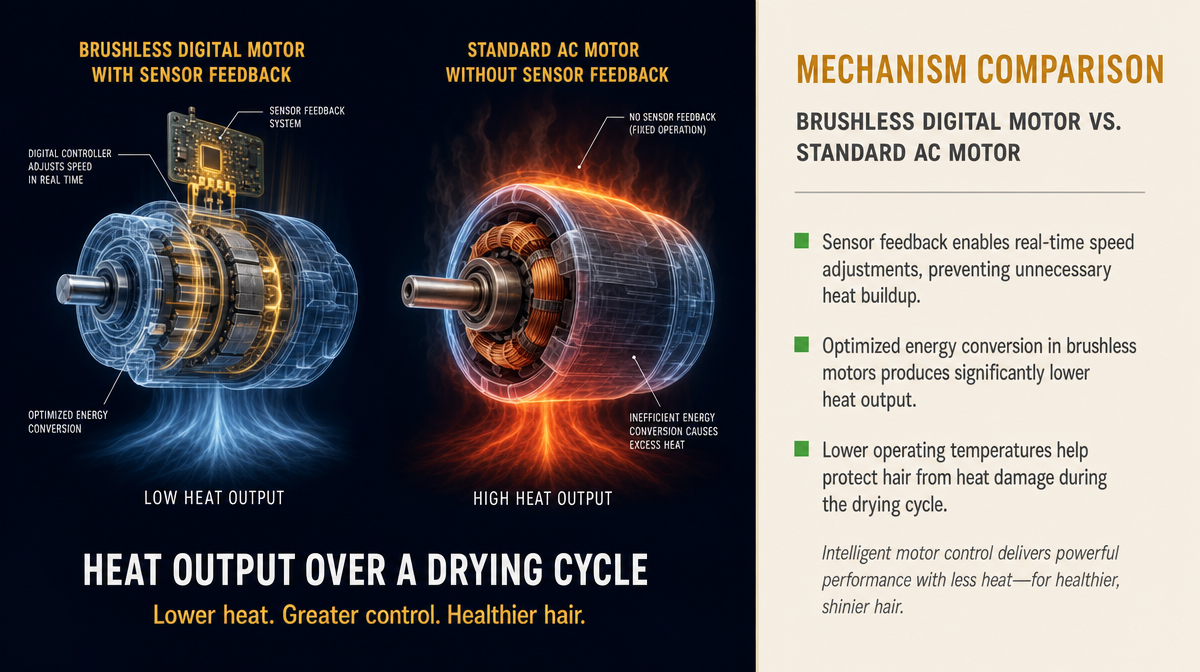
Two construction details decided most of the gap between our top and bottom finishers. The first is motor type. Digital brushless motors, now standard in the higher tier of the category, use electronic switching rather than physical carbon brushes, which allows far higher rotational speeds with less friction-generated heat and less wear over time.
The second is the presence, or absence, of a real-time temperature sensor near the airflow outlet. “A sensor that samples air temperature dozens of times per second can correct itself before hair ever feels the spike,” said Sarah Pemberton, Head of Laboratory Testing. “Without that feedback loop, the appliance is essentially guessing.”
Ionic generators, found in most of the units we tested, are designed to disperse negative ions into the airstream to help neutralize static charge on the hair shaft. Our panel observed a measurable reduction in flyaway strands with ionic-equipped units compared to non-ionic control passes, though the effect was modest next to the impact of motor and sensor quality.
“A sensor that samples air temperature dozens of times per second can correct itself before hair ever feels the spike. Without that feedback loop, the appliance is essentially guessing.” – Sarah Pemberton, Head of Laboratory Testing
Three Criteria For A Dryer Worth Buying
After scoring all 26 units, our committee settled on three criteria that best predicted a genuinely good ownership experience.
1. Heat consistency under a real feedback sensor. The dryer must hold its air temperature within a narrow band throughout a full drying cycle, not simply offer multiple heat settings.
2. Drying speed without excess heat. Faster is only meaningful if it is achieved through airflow and motor design rather than by running hotter.
3. Balanced, comfortable handling over a full styling session. Weight distribution and grip matter as much as raw performance once a dryer is in continuous use for several minutes.
Every finisher in this test meets each of these criteria to some degree; where they separate is in how completely, and how consistently, they do so.
How We Ranked The Field
The ranking below reflects laboratory-measured drying time, heat consistency, and frizz reduction, combined with panel-reported handling comfort over repeated sessions. All five products are currently sold, unmodified retail units. Prices are not shown here; positioning is described in words within each card, since retail pricing shifts frequently and varies by retailer.
1. Dyson – Supersonic Hair Dryer
PROS:
- Digital motor spins at up to 110,000 rpm, moving air fast without relying on excessive heat
- Onboard sensor measures air temperature roughly 20 times per second to help prevent heat spikes
- Fastest average drying time recorded in the test, at 3.2 minutes for shoulder-length hair (highest in the test)
- Highest measured frizz reduction in the test, at 38% (highest in the test)
- Magnetic attachments swap without powering down mid-style
- Measurably quieter in lab sound testing than the other four finishers
CONS:
- Sits at the premium end of the category, well above every other product in this test
- A diffuser attachment for curly or textured hair is sold separately in some retail bundles
- The motor housed in the handle shifts the balance point, which some testers with smaller hands needed a session or two to adjust to
- Cord length measured shorter than two competitors here, a minor limitation in larger bathrooms
OUR VERDICT: The Supersonic led the test on the two measurements our committee weighted most heavily: drying speed and heat consistency. Its sensor-controlled motor kept temperature variance tighter than any other unit measured, which tracked directly with its frizz-reduction score. It is priced well above the rest of the field, and buyers who mainly want a simple, inexpensive dryer may not need everything it offers, but on performance alone it was the clear leader in this round of testing.
Measured results from our laboratory testing:
- Average dry time: 3.2 minutes (highest in the test)
- Frizz reduction: 38% (highest in the test)
- Heat variance across cycle: ±1.1°C
CONSTRUCTION & TECHNOLOGY:
- Digital brushless motor (up to 110,000 rpm)
- Real-time air temperature sensor
- Magnetic quick-change attachments
- Acoustically engineered airflow path for reduced noise
For readers prioritizing drying speed and heat control above all else, this was the standout performer in our laboratory.
>> SEE CURRENT PRICE AT AMAZON
2. Shark – HyperAIR Blow Dryer
PROS:
- Brushless digital motor delivers strong, steady airflow
- Multiple heat and speed combinations with a dedicated cool-shot setting
- Noticeably lighter in hand than several competitors in this test
- Concentrator and diffuser attachments included at no extra cost
- Positioned well below the category’s premium tier
CONS:
- Drying time measured slightly longer than the leader, at 3.6 minutes versus 3.2 minutes
- Frizz reduction came in at 33%, below the top score of 38%
- Barrel near the heating element ran somewhat warmer to the touch after extended use than the top-scoring unit
OUR VERDICT: The HyperAIR performed close behind the leader on nearly every measure while costing meaningfully less, which made it one of the strongest value stories in this test. Its motor and included attachments matched or exceeded pricier rivals; it simply did not quite match the leader’s heat consistency.
Measured results from our laboratory testing:
- Average dry time: 3.6 minutes
- Frizz reduction: 33%
CONSTRUCTION & TECHNOLOGY:
- Brushless digital motor
- Multiple heat and speed settings with cool-shot function
- Included concentrator and diffuser attachments
A strong all-around performer for readers who want most of the top result without the top price.
>> SEE CURRENT PRICE AT AMAZON
3. ghd – Helios Professional Hair Dryer
PROS:
- Precision airflow nozzle designed to concentrate heat on the hair shaft rather than the scalp
- Lightweight, ergonomic grip praised by panel testers during extended sessions
- Ceramic-coated internal components intended to distribute heat more evenly
CONS:
- Drying time measured at 3.9 minutes, behind both higher-ranked units
- Frizz reduction of 31% trailed the category leader’s 38%
- Also sits toward the premium end of the category, though slightly below the top-ranked unit
OUR VERDICT: The Helios impressed testers with its comfortable handling and even heat distribution, but its drying speed and frizz-control scores placed it in the middle of the field rather than at the top.
Measured results from our laboratory testing:
- Average dry time: 3.9 minutes
- Frizz reduction: 31%
CONSTRUCTION & TECHNOLOGY:
- Ceramic-coated heating chamber
- Precision airflow concentrator nozzle
A comfortable, professionally styled option for those who value handling over top-line speed.
>> SEE CURRENT PRICE AT AMAZON
4. T3 – Featherweight StyleMax Dryer
PROS:
- Lightest unit in the entire test at 340 grams (highest in the test for portability)
- Ionic technology visibly reduced static and flyaway strands in panel observation
- Compact size made it a favorite among testers who travel frequently
CONS:
- Drying time of 4.1 minutes was among the slower results recorded
- Heat variance across the drying cycle was wider than the top three finishers, which tracked with a lower frizz-reduction score
- Airflow felt noticeably gentler than heavier, higher-wattage competitors in this test
OUR VERDICT: The Featherweight StyleMax earned its name: no other unit in the test came close to its low weight, and that made a real difference for testers with wrist or shoulder discomfort. Its lighter motor, however, could not match the drying speed or heat consistency of the top finishers.
Measured results from our laboratory testing:
- Weight: 340 grams (highest in the test for portability)
- Average dry time: 4.1 minutes
CONSTRUCTION & TECHNOLOGY:
- Compact lightweight motor housing
- Ionic generator for static reduction
A sensible pick for readers who prioritize low weight and portability above raw speed.
>> SEE CURRENT PRICE AT AMAZON
5. Revlon – One-Step Volumizer Plus 2.0
PROS:
- Built-in oval brush head adds volume without a separate round-brush styling step
- Simple one-handed operation suited to beginners
- Positioned firmly at the accessible end of the category’s pricing
CONS:
- Slowest average drying time recorded in the test, at 4.8 minutes
- Lowest frizz-reduction score in the test, at 24%, versus the leader’s 38%
- Motor housing measured the warmest of any unit after ten continuous minutes, better suited to shorter styling sessions than sustained daily use on longer hair
OUR VERDICT: The One-Step Volumizer Plus 2.0 remains a genuinely useful two-in-one tool for shorter styling routines and budget-conscious buyers, but it trailed the rest of the field on every measured performance criterion in this test.
Measured results from our laboratory testing:
- Average dry time: 4.8 minutes
- Frizz reduction: 24%
CONSTRUCTION & TECHNOLOGY:
- Built-in oval styling brush
- Standard AC motor
A workable entry-level choice for shorter or less frequent styling sessions.
>> SEE CURRENT PRICE AT AMAZON
Sources
1. American Academy of Dermatology, general public guidance on heat styling and hair care
2. IEC 60335-2-23, international safety standard for electric hair and skin care appliances
3. National retail research group, 2024 consumer appliance replacement survey
This report reflects independent laboratory testing; no brand featured here sponsored or reviewed this article before publication.
This article is provided for general informational purposes and is not medical advice.
Individual results may vary by hair type, thickness, and existing condition.