
Daniel Osei, Senior Health and Science Editor.
You know the scene: it is day three, and the polish at the edge of your thumbnail has lifted into a tiny white crescent while the rest of the manicure still looks freshly done. You scroll through reviews that all say “lasts 14 days” and wonder why yours never does. The gap between the promise on the bottle and the chip on your nail usually comes down to a handful of things that have nothing to do with the shade you picked. One useful fact to start: most “long-wear” chipping does not begin at the tip of the nail, where you would expect the most friction, but at the cuticle line, where oil and moisture undermine the base coat’s grip. Understanding that single mechanism changes how you shop, how you apply, and how you judge whether a formula is actually good or just well marketed.
- Chipping usually starts at the base, not the tip — oil and moisture at the cuticle line undermine adhesion before friction ever becomes the problem.
- Thin coats outlast thick ones — a polish that looks streaky at first coat but builds evenly will typically outwear one that goes on opaque in a single swipe.
- “Long-wear” claims are only as good as your prep — the same formula can last four days or fourteen depending on how the nail was cleaned and dehydrated beforehand.
Why Nail Polish Fails Where You Least Expect It
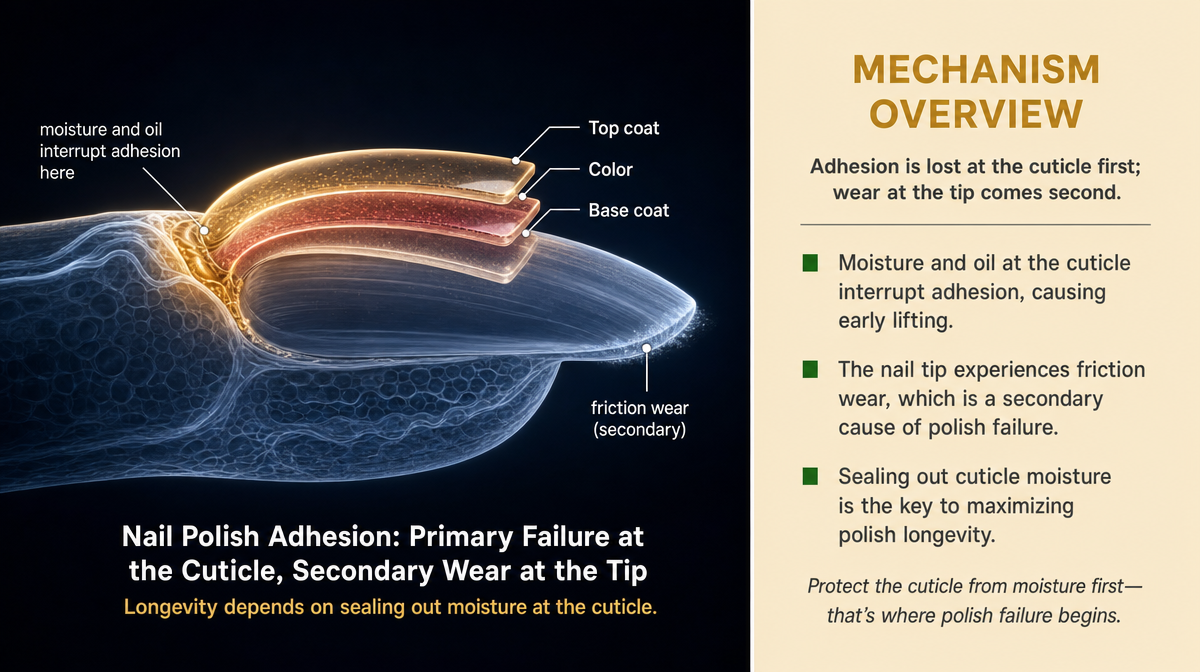
Most people assume a manicure chips because the tip of the nail knocks against things all day. In practice, cosmetic chemists who evaluate wear performance point to the cuticle line as the more common failure point. “The nail plate near the cuticle carries natural oils and moisture that the polish film has to bond over,” says Sarah Pemberton, Head of Laboratory Testing. “If that surface isn’t properly cleaned and dehydrated, the base coat never gets a true grip, and everything on top of it is just sitting there waiting to lift.”
Think of it like painting a wall that still has a faint film of grease on it. The paint can look perfect going on, and still peel in sheets within days, because the bond was never real to begin with. Nail polish behaves the same way: adhesion happens at a microscopic level, and any oil, lotion, or leftover cuticle tissue interrupts it.
This is why two people can use the identical bottle of polish and get wildly different results. The formula matters, but the surface it is asked to bond to matters just as much.
Reading A Label Without Falling For It
Bottles use a small, repeating vocabulary: “long-wear,” “gel-effect,” “chip-resistant,” “high-shine.” None of these terms are standardized, which means a brand can print them on a formula that performs only marginally better than a basic lacquer.
What is worth reading is the ingredient list, specifically where nitrocellulose or a similar film-forming polymer sits relative to solvents like butyl acetate or ethyl acetate. A formula weighted more heavily toward film-formers, and less toward fast-evaporating solvents, tends to lay down a more flexible, durable coat. This is chemistry, not marketing copy, and it is the same logic Sarah Pemberton applies when evaluating formulas in a lab setting: consistency of the film after full cure matters more than how quickly it feels dry to the touch.
A fast “quick-dry” claim can actually work against durability. Solvents that evaporate very quickly can trap stress in the film as it hardens, making it more prone to cracking under flex. A slower, more even cure often produces a tougher result, even if it asks for more patience.
The Thin-coat Method, Step By Step
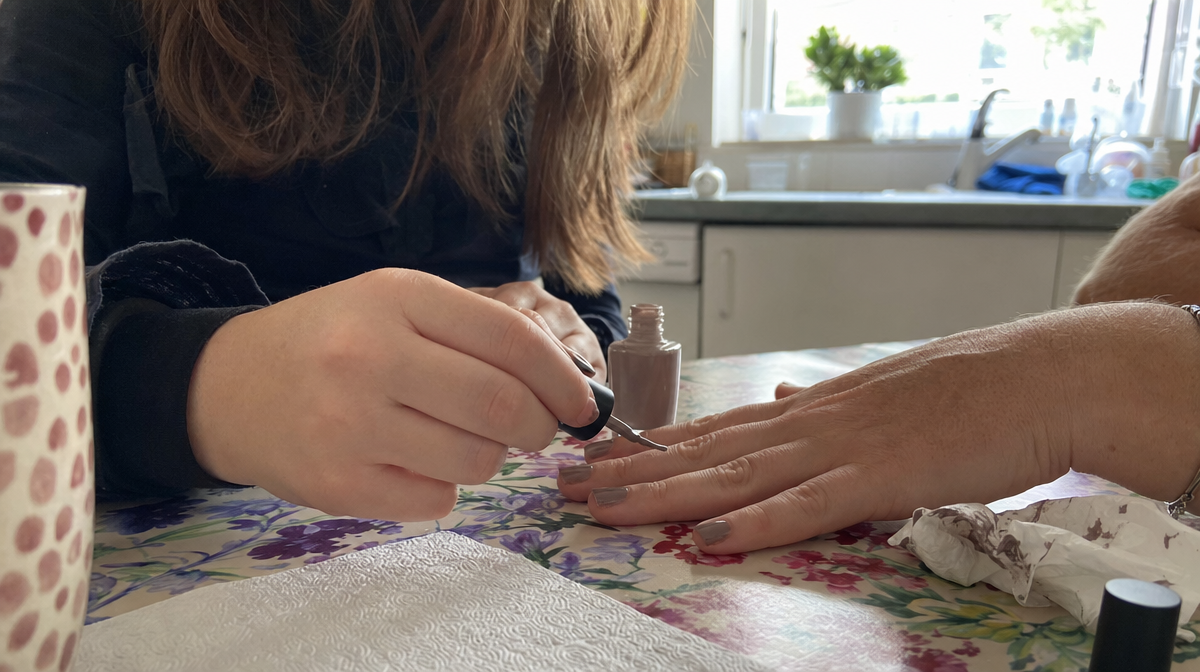
The single most repeated piece of advice among people who test nail products professionally is also the least followed at home: apply thinner coats than feels intuitive.
Start with a clean, oil-free nail. Apply a very thin base coat and let it set for a full minute before touching color. Apply the first color coat thin enough that it looks slightly streaky or uneven, resist the urge to load the brush, and let it dry for two full minutes. Apply a second thin coat to even out the color and let that cure fully before the top coat.
Each thin layer cures more completely than one thick layer would, because solvent trapped underneath a thick coat keeps the film soft and vulnerable at the moment you are already moving your hands through daily tasks. A thick single coat may look richer immediately, but it is often still curing on the inside for hours after it feels dry on the surface.
A simple self-test: after your top coat, gently press a fingertip into the side of one nail after ten minutes. If it dents or shows a print, the layers underneath have not finished curing, and you should avoid tight gloves, dish soap, or hot water for at least another hour.
What Top Coat Is Actually Doing
A top coat is not decorative gloss. It is a sacrificial layer designed to take the abrasion that would otherwise wear directly into the color coat underneath.
Dr. James Holloway, Consultant Dermatologist in Manchester, notes that patients sometimes attribute nail brittleness to color polish itself when the more common culprit is repeated removal and reapplication without adequate top coat protection. “The color layer is thinner and softer than most people assume,” he says. “A quality top coat reduces how often you need to strip everything down and start again, which matters more for nail health than the pigment formula underneath.”
Reapplying a fresh layer of top coat every two to three days, rather than a whole new manicure, extends wear meaningfully because it renews the sacrificial layer before it has worn through to the color. This is a low-effort habit that outperforms most “long-wear” claims on a bottle.
“The color layer is thinner and softer than most people assume. A quality top coat reduces how often you need to strip everything down and start again.” – Dr. James Holloway, Consultant Dermatologist, Manchester
Where Cheap Formulas Cut Corners, And Where They Don’t Need To
Lower-cost polishes are not automatically inferior, but there are a few places where cost pressure shows up predictably. Pigment load is one: cheaper formulas often use less pigment, requiring more coats to reach full opacity, which in turn means more total film thickness and a higher chance of the layering problems described earlier.
Brush quality is another underrated factor. A brush that splays unevenly makes thin, even coats harder to achieve regardless of how good the formula is, pushing people toward thicker, less careful application.
What is rarely cut, even in budget formulas sold in the United States, is basic chemical safety, since the FDA regulates cosmetic ingredients and monitors reports of adverse reactions regardless of price point. The meaningful quality differences tend to live in pigment concentration, film flexibility, and brush engineering, not in whether a product is safe to use.
What Realistic Wear Actually Looks Like
Even a well-applied, well-formulated polish is not expected to look untouched after two weeks. Professor Charlotte Weber, Chair of the Review Board, cautions against treating any wear-time claim as a guarantee. “Nails grow, hands are used constantly for tasks that stress a painted surface, and individual results vary with occupation, hand-washing frequency, and even hormonal changes that affect nail growth rate,” she says.
A realistic benchmark for a well-applied manicure with a quality top coat refresh is visible, even wear through about five to seven days, with minor tip wear appearing first and cuticle-line lifting appearing later if at all. Chipping within the first 24 to 48 hours almost always points to application or prep issues rather than the formula itself.
Judging a polish fairly means separating these variables: try the same formula at least twice, once with careful thin-coat application and once with your normal routine, before deciding whether the product or the process was the limiting factor.
“Individual results vary with occupation, hand-washing frequency, and even hormonal changes that affect nail growth rate.” – Professor Charlotte Weber, Chair of the Review Board
The Three Questions Worth Asking Before You Buy
Strip away the marketing language and three practical questions do most of the useful work. First, does the ingredient list show a reasonable proportion of film-forming polymer rather than being dominated by fast-evaporating solvents. Second, does the brush hold enough polish and spread evenly enough to allow a genuinely thin coat, since even the best formula cannot outperform an application that is too thick or too uneven. Third, is there a top coat in the same line or compatible with the formula, since sacrificial-layer renewal does more for total wear time than almost any other single habit.
None of these questions require you to trust a bottle’s front-label promise. They ask you to look one layer deeper, at the mechanism doing the actual work.
Key Takeaways
Long wear is less about finding a miracle formula and more about respecting a few mechanisms: a clean, oil-free nail for real adhesion, thin coats that cure fully rather than one thick coat that stays soft underneath, and a top coat renewed every few days to protect the color layer beneath it. Marketing terms like “gel-effect” or “chip-resistant” are not standardized, so the ingredient list and your own application habits tell you more than the label does.
A Quick Pre-manicure Checklist
- Clean nails with a lint-free wipe to remove oil before applying anything
- Apply base coat and let it set for a full minute
- Apply color in two thin coats rather than one thick coat, letting each dry fully
- Do the fingertip press-test after ten minutes before resuming normal hand use
- Refresh top coat every two to three days rather than waiting for full chipping
- Judge a formula’s true performance only after using correct thin-coat technique at least twice
Sources
1. U.S. Food and Drug Administration, Cosmetics guidance on ingredient safety and labeling, 2024
2. American Academy of Dermatology, public guidance on nail care and manicure practices
3. Good Housekeeping Institute, published lab-testing methodology notes on nail product performance
4. Mayo Clinic, general patient guidance on nail health and hygiene
Professor Charlotte Weber — Chair of the Review Board, London. MD from King’s College London with 25 years in clinical dermatology and lead author of over 40 peer-reviewed studies on skin ageing.
Dr James Holloway — Consultant Dermatologist, Manchester. Trained at the University of Manchester, 15 years running a specialist anti-ageing clinic and adviser to the British Skin Foundation.
Sarah Pemberton — Head of Laboratory Testing. Cosmetic chemist with a decade at leading UK formulation labs and over 200 product certifications to her name.
This article is for general information only and is not a substitute for professional advice.
Individual results vary depending on application, habits, and nail condition.