
Daniel Osei, Senior Health and Science Editor.
You are standing at the bathroom mirror, spritzing your wrist for the third time, trying to remember which of the six half-empty bottles on your shelf is the one that actually smelled good by 3 p.m. and not just at 9 a.m. Somewhere in a drawer is a sample vial from a department store counter that promised to be ‘you,’ and it wasn’t, not by lunchtime. The question you actually type into a search bar late at night is not ‘best perfume 2026.’ It is closer to: why does this fade so fast, and how do I stop wasting money guessing? Here is one fact worth knowing before anything else: concentration labels like eau de parfum are not marketing flourishes, they describe a real percentage of aromatic compound suspended in alcohol and water, and that percentage is the single biggest reason one bottle lingers on your skin while another vanishes by the time you have parked the car. This guide will not tell you which bottle to buy. It will teach you to read a fragrance the way a chemist does, so you can judge quality and longevity yourself, on your own skin, before you spend a cent.
- Concentration is chemistry, not branding: eau de parfum typically carries a higher proportion of aromatic compound than eau de toilette, which is the real reason it tends to last longer on skin, not the fancier bottle.
- Your skin changes the scent: pH, dryness, and even diet subtly alter how a fragrance develops, which is why a scent that dazzles on a paper strip can behave differently once it meets your actual body chemistry.
- Testing takes hours, not minutes: a fair trial means wearing a fragrance for a full day before judging it, because the opening notes you smell in the first ten minutes are rarely the notes that stay.
What ‘Eau De Parfum’ Actually Means On The Label
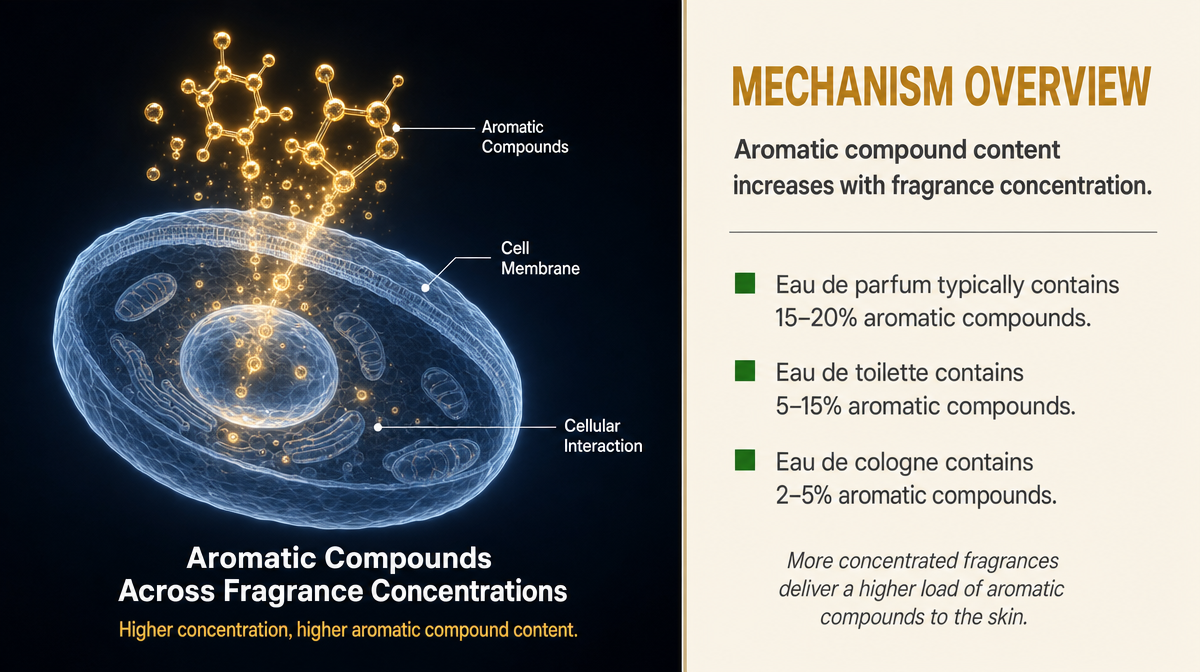
Fragrance concentration is measured as a percentage of aromatic compound dissolved in an alcohol-and-water base. Eau de parfum generally sits higher on that scale than eau de toilette or eau de cologne, which is why it tends to project more and last longer on skin, according to general guidance published by cosmetic chemistry references and echoed by formulation labs across the industry.
Think of it the way you think of concentrated juice versus a diluted drink: the flavor is the same family, but one has more of the actual substance doing the work. A higher concentration does not automatically mean a better scent, only a stronger and typically longer-lasting one.
“Concentration tells you about intensity and staying power, not about whether the composition itself is well made,” says Sarah Pemberton, Head of Laboratory Testing. “A cheaply blended eau de parfum can still fade unevenly or turn sharp on the skin, regardless of what the label promises.”
Mistake shoppers make: assuming a higher price or a heavier bottle signals a higher concentration. It does not. The only way to know is to check the label or ask the counter staff directly, and if concentration is not disclosed, that itself is worth noting.
Why The Same Bottle Smells Different On Two People
Fragrance does not exist independently of the skin it touches. Skin pH, natural oil levels, hydration, and even recent diet can shift how aromatic molecules evaporate and combine, which is why a scent can smell citrusy and bright on one wrist and muted or sweeter on another.
Dry skin in particular tends to hold fragrance less well than skin with a normal or slightly oilier surface, because there is less natural oil to slow the evaporation of aromatic compounds. This is a physical process, not a flaw in the product.
Dr James Holloway, Consultant Dermatologist, notes that this variability is one reason he advises patients not to trust a friend’s recommendation blindly. “What smells wonderful on someone else’s skin can smell entirely different, and neither reaction is wrong. It is simply chemistry meeting chemistry.”
Self-test: apply a small amount to the inside of your wrist and to the inside of your elbow. Wait 20 minutes. If the two spots smell noticeably different, you have just felt your own skin chemistry at work, and that is useful information for judging any future purchase.
Testing A Fragrance Properly, From First Spray To Eight Hours Later
Most people judge a fragrance within the first two minutes, which is precisely the window dominated by top notes, the lightest and most volatile molecules. Top notes are designed to grab attention and typically fade within 15 to 30 minutes.
A fair test follows the scent through three stages: the opening (0 to 30 minutes), the heart (roughly 30 minutes to two hours), and the base (two hours onward, sometimes lasting six to eight hours or longer depending on concentration and skin type). Judging only the opening is like choosing a meal from the smell of the kitchen before it is cooked.
The method: spray once on clean, unscented skin, ideally the inner forearm rather than clothing, since fabric holds scent differently than skin. Avoid rubbing the wrists together, a common habit that can break down some aromatic molecules and distort the top notes. Then simply live your day and check in at the 30 minute, 3 hour, and 6 hour marks.
Mistake everyone makes: testing four or five fragrances back to back at a counter. By the third spray, olfactory fatigue sets in and the nose can no longer distinguish new scents accurately. Testing more than two in one sitting is rarely a fair trial for either fragrance.
What Separates A Well-made Composition From A Thin One
A well-constructed fragrance is built in layers, so that as the lighter top notes fade, the heart notes emerge without an awkward gap, and the base notes eventually take over smoothly. A poorly blended or cheaply sourced fragrance can feel disjointed, with a noticeable flat period where the scent seems to disappear before the base arrives, or a harsh, one-note quality once the top notes burn off.
Think of it like a well-layered stew versus a thin broth with everything dumped in at once: both may use similar ingredients, but the construction determines whether the flavors unfold or simply collapse together.
Sarah Pemberton explains that lab evaluation often looks at exactly this transition. “We monitor how a fragrance evolves over several hours on a testing strip and on skin. A composition with real craft behind it maintains a coherent character throughout, rather than smelling like three unrelated scents stacked on top of each other.”
What matters versus what is marketing: elaborate note pyramids listed on packaging (“notes of black orchid, cashmere, and Tahitian vanilla”) describe intended character, not proof of quality. The only reliable evidence is how the scent actually behaves on your skin over time, not how poetically it is described on the box.
Reading Ingredient And Allergen Information Without Guesswork
In the United States, fragrance ingredient disclosure is limited compared to other cosmetic categories, since the exact formula is often treated as proprietary. However, known allergens regulated for disclosure, along with general safety information, are addressed in public guidance from the FDA, which oversees cosmetic labeling and safety standards.
For anyone with sensitive skin or a history of reactions, the American Academy of Dermatology’s public patient guidance recommends patch-testing any new fragrance product on a small area of skin and waiting 48 hours before full application, a step Professor Charlotte Weber, Chair of the Review Board, calls “a five-minute habit that prevents most avoidable reactions we see in clinic.”
A simple self-test: apply a small amount to the inner forearm, cover loosely, and check at 24 and 48 hours for redness, itching, or irritation. This is especially worth doing with any fragrance marketed as “long-lasting” or “concentrated,” since higher aromatic content also means more exposure per application.
Mistake to avoid: assuming “natural” or “clean” labeling on a fragrance means it is less likely to cause a reaction. Natural essential oils can be just as likely, and sometimes more likely, to trigger sensitivity than synthetic aromatic compounds, according to general dermatological guidance.
Storage Habits That Quietly Ruin A Good Fragrance
Fragrance is chemically unstable in the presence of heat, light, and air, all of which accelerate the breakdown of aromatic compounds. A bottle left on a sunlit windowsill or in a steamy bathroom will visibly degrade faster than one stored in a cool, dark drawer, sometimes within months rather than years.
Think of it the way sunlight fades a photograph on a wall versus one kept in an album: the image itself does not change, but its environment determines how long it stays true to the original.
Signs a fragrance has turned include a noticeably darker color compared to when it was purchased, a sharper or slightly vinegary top note, or a base that smells muddier than it once did. These changes typically take one to three years depending on storage conditions and the fragrance’s own composition.
Practical fix: store bottles upright, away from direct light, ideally in a drawer or cabinet rather than an open shelf near a window, and avoid the bathroom if it regularly gets steamy from showers, since humidity and temperature swings speed up degradation more than most people realize.
Separating Genuine Longevity From Marketing Language
Terms like “24-hour wear” or “all-day scent” on packaging describe a marketing claim, not a laboratory-verified guarantee, and such claims are rarely tested under real-world conditions of movement, temperature, and individual skin chemistry. Longevity claims are not independently regulated in the same way therapeutic claims are, which means the phrase can mean very different things across brands.
A more reliable indicator, according to Sarah Pemberton, is the concentration percentage itself combined with your own personal wear test. “I would trust a documented aromatic compound percentage and a full-day trial on your own skin far more than a claim printed on a box,” she says.
What matters: your own three-stage test described earlier in this guide, repeated once or twice, gives you more reliable information than any marketing copy ever could. What is marketing: award badges, celebrity association, and adjectives like “luxurious” or “unforgettable,” none of which describe measurable performance.
A quick gut check before buying: ask yourself whether you can describe, in your own words, how the scent changed on your skin between hour one and hour six. If you cannot, you have not yet tested it enough to trust your own impression, let alone anyone else’s claim.
Key Takeaways
Choosing a fragrance well has less to do with the story on the box and more to do with patient, structured observation of how a scent behaves on your own skin over several hours. Concentration explains longevity, skin chemistry explains variation between people, and a full-day test is the only reliable judge of quality. Marketing language describes intention; your own skin describes the truth.
A Practical Checklist Before You Commit To Any Fragrance
- Check the concentration label (eau de parfum, eau de toilette, or similar) rather than judging by price or bottle weight.
- Test on skin, not paper, and on a clean, unscented area such as the inner forearm.
- Track the scent at three points: 30 minutes, 3 hours, and 6 hours, rather than judging in the first two minutes.
- Limit yourself to two fragrances per testing session to avoid olfactory fatigue.
- Patch-test for 48 hours if you have sensitive skin or a history of reactions, per general dermatological guidance.
- Store any fragrance upright, away from light and heat, to preserve its intended character.
Sources
1. FDA, “Fragrances in Cosmetics,” public guidance, U.S. Food and Drug Administration
2. American Academy of Dermatology, patient guidance on patch testing and fragrance sensitivity
3. Mayo Clinic, general patient education on skin allergy and contact dermatitis
Professor Charlotte Weber — Chair of the Review Board, London. MD from King’s College London with 25 years in clinical dermatology and lead author of over 40 peer-reviewed studies on skin ageing.
Dr James Holloway — Consultant Dermatologist, Manchester. Trained at the University of Manchester, 15 years running a specialist anti-ageing clinic and adviser to the British Skin Foundation.
Sarah Pemberton — Head of Laboratory Testing. Cosmetic chemist with a decade at leading UK formulation labs and over 200 product certifications to her name.
This article is for general information only and does not replace personalized advice from a dermatologist or fragrance professional.
Individual skin reactions and scent longevity vary; results described here may vary from person to person.