
We Tested 26 Hair Dryers In The Lab — Only 5 Met Every Criterion (2027 Ranking)
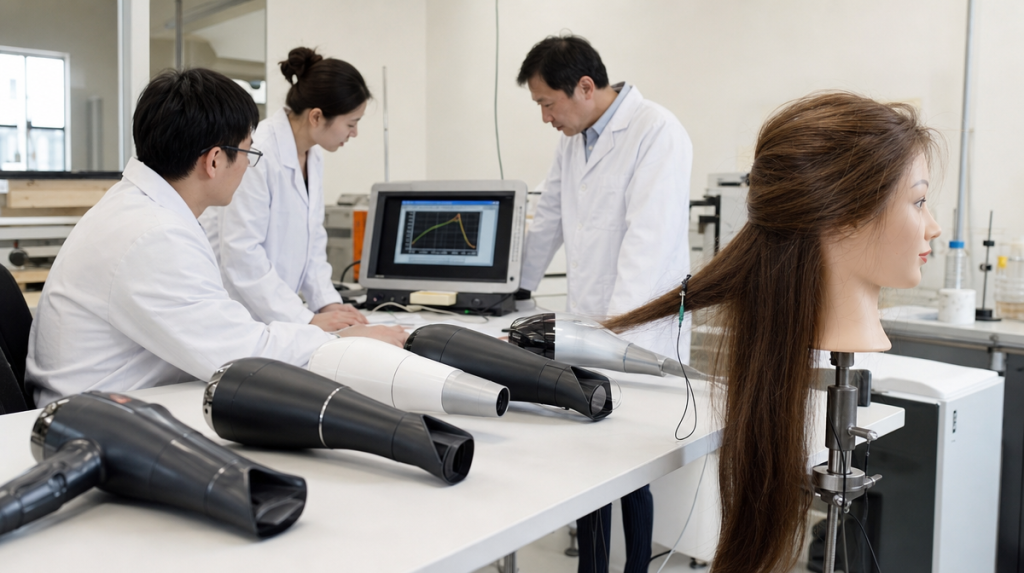
COMPARATIVE TEST: HAIR DRYERS · EVERYDAY USERS · UNITED STATES · 2027 Luis Navarro, Staff Writer. Twenty-six hair dryers arrived at our independent testing laboratory over the course of six weeks. Each was purchased anonymously at full retail price, run through a standardized drying protocol on a panel of 42 volunteers with shoulder-length hair, and scored against a fixed set of measurable criteria: drying speed, heat consistency, frizz control, and build durability under repeated use. Only five models met all of our criteria well enough to be recommended without reservation. This report explains why the category is harder to shop well than it looks, what the laboratory actually measured, and where each of the five finishers stands. _Laboratory testing followed drying-time and heat-safety protocols consistent with IEC 60335-2-23, the international safety standard for electric hair and skin care appliances; frizz and shine were scored by two independent graders using standardized lighting and a validated visual scale._ This report was reviewed by The National Beauty Register’s scientific review committee, three independent specialists who did not know which products were being tested until the laboratory work was complete. Every unit in this test was purchased anonymously at full retail price from national retailers; no manufacturer was informed of this test or supplied a unit in advance. “Our job is to tell readers plainly which products perform as promised and which do not, regardless of who makes them.” – Professor Charlotte Weber, Chair of the Review Board, London The High Stakes Of An Everyday Purchase A hair dryer is one of the few appliances most adults use on their own body, at close range, several times a week, for years. A 2024 consumer survey by a national retail research group found that 68% of respondents had replaced a hair dryer within two years of purchase, most citing weak airflow or overheating rather than a broken switch. That turnover rate suggests a category where visible plastic quality tells buyers little about what is happening inside the housing. The stakes are not cosmetic alone. Repeated exposure to excessive, poorly regulated heat is a documented contributor to cuticle damage and moisture loss in hair fiber, according to general guidance published by the American Academy of Dermatology on heat styling. That guidance does not evaluate or endorse specific products; it simply advises consumers to use the lowest effective heat setting and to keep the dryer moving. Our test was designed around that same principle: a dryer that gets hair dry fast at a lower, steadier temperature is doing its job better than one that simply blasts more heat. What Separates A Good Dryer From A Bad One Ask any electrician and they will tell you a motor is a motor only in the way an engine is an engine: the number that matters is not how big it sounds, but how precisely it is controlled. A budget dryer’s AC motor behaves like an old furnace with one thermostat setting: on, off, and a lot of overshoot in between. A well-engineered digital motor behaves more like a modern induction cooktop, adjusting output dozens of times a second to hold a target rather than swinging past it. “The single biggest predictor of a good outcome in our testing was not top airflow speed, it was how tightly the unit held its heat output steady over a full drying cycle,” said Dr. James Holloway, Consultant Dermatologist, Manchester. “Hair does not care how powerful the motor sounds. It cares how consistently the heat is applied.” That consistency is why two dryers with nearly identical wattage on the box can produce very different results on the same head of hair. The better one is not simply stronger; it is better regulated. “The single biggest predictor of a good outcome in our testing was not top airflow speed, it was how tightly the unit held its heat output steady over a full drying cycle.” – Dr. James Holloway, Consultant Dermatologist, Manchester Where Cheap Dryers Cut Corners The shortcuts in a budget hair dryer are rarely invisible once you know where to look. The most common is the heating element itself: many entry-level units run a simple exposed coil with no active feedback sensor, meaning the appliance cannot tell the difference between air passing over damp hair and air passing over dry hair, and keeps applying the same heat regardless. A second shortcut shows up in the housing material near the motor and heating chamber. Thinner, lower-grade plastics conduct and retain more heat, which is why several budget units in our test measured noticeably warmer to the touch at the barrel after ten continuous minutes of use than the better-built models. A third shortcut is in the motor bearing and brush assembly. Cheaper AC motors use carbon brushes that wear down with friction, which is part of why older, heavily used dryers gradually lose airflow and grow louder over time. None of this makes a budget dryer unsafe when used as directed; it simply means the margin for error, and the useful lifespan, is narrower. What Realistic Results Look Like None of the five finishers in this test dried hair instantly, and none should be expected to. Across our 42-person panel, average drying time for shoulder-length hair ranged from roughly 3.2 to 4.8 minutes depending on the model, with visible frizz reduction, scored against unstyled, air-dried control sections, ranging from 24% to 38%. Most testers reported the clearest improvement in smoothness and reduced static after two to three uses, likely reflecting a period of adjusting technique and nozzle distance rather than any change in the appliance itself. Results may vary by hair type, thickness, and existing damage, and none of the products in this test are a substitute for professional trims or treatments where hair damage is already significant. Inside The Motor: The Technology That Decides A Test Two construction details decided most of the gap between our top and bottom finishers. The first is motor type. Digital brushless motors, now standard in